Attleboro, Massachusetts, June 10, 2021, 5:30 a.m.-6:31 a.m. EDT
8×32 Lunt Sunoculars, 6×30 Lunt Sunoculars, welder’s glass, eclipse glasses


Attleboro, Massachusetts, June 10, 2021, 5:30 a.m.-6:31 a.m. EDT
8×32 Lunt Sunoculars, 6×30 Lunt Sunoculars, welder’s glass, eclipse glasses

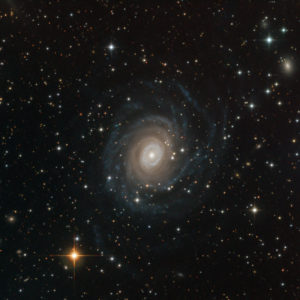
The SPECULOOS Southern Observatory saw first light in December 2017. Located at ESO’s Paranal Observatory in Chile, SPECULOOS is designed to hunt for exoplanets around small, cool stars.
This image of NGC 6902, a galaxy about 120 million light-years from Earth in the direction of Sagittarius, was taken to test one of the four 1-meter telescopes that comprise SPECULOOS.
Visit the ESO site to download high-res versions of this image.
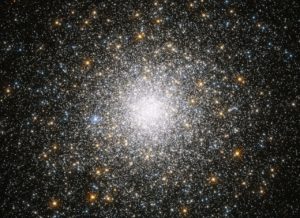
Messier 75 is a lot less dazzling through the telescope. Although I can nearly always detect a brightening at the core, it takes more than a 10-inch scope to resolve individual stars (I’m not sure I’ve ever resolved any). Still, M75 is a fun target. It’s a noticeably non-stellar patch of circular fuzz.
Click through the image to download a screen-size .jpg or publication quality .tiffs.

Celestial Calendar always starts on page 48.

Snapshots of the March 2018 Celestial Calendar.
Have you ever wondered what goes into producing the Celestial Calendar for an issue Sky & Telescope? Conceptually, it’s simple: look at various sources of information, find out what’s going on in the sky in a given month, and write 2–3 pages about it. Easy! But it sure didn’t feel easy when I took over CelCal in 2017.
Actually, I’ve been responsible for several parts of CelCal since 2014. Once a year, I retrieve predictions for the Phenomena of Jupiter’s Moons from IMCCE. Each month, I take the relevant section and format it for the magazine and website. I also run all the Algol predictions as well as the Great Red Spot predictions for the magazine, using proprietary software developed by Roger Sinnott (our online tools were designed mostly by Adrian Ashford).
New to me in 2017 was writing the “Action at Jupiter” section (though it’s an easy task, since I pay a lot of attention to Jupiter anyway). I knock that out in much less than an hour. Being responsible for the Jupiter’s Moons “wigglegram” was also new to me. Roger still produces the wigglegram each month and submits it to our design department. After they are done with it, I proof it and okay it for the magazine.
So, that covers about 1 to 1-1/2 pages of CelCal. I fill the other 3 (sometimes 4, as we don’t run Algol predictions in the summer, and we don’t run Jupiter info when Jupiter is in conjunction with the Sun) with whatever I think best fits the month.
I use both a paper and computer file system for planning. The computer files mostly hold data I’ve collected to create our annual Observing Calendar. I do that work more than a year ahead (for instance, it’s January 2019 as I write this, but I finished the data for the 2020 calendar a month ago), so I always have a lot data on hand, well in advance.

A Word doc I used to plan the 2018 S&T Observing Calendar.
My paper system includes a manila folder each month. I sort the hard copies of anything I used for the Observing Calendar into them: photocopies from the Astronomical Almanac and Sun, Moon and Planets (Meeus), printouts of maps and predictions for lunar and solar eclipses, early comet predictions, hard copies of meteor shower data from IMO, preliminary lists of asteroid/lunar occultations (I use Occult v.4.x to check final predictions), and so on, into the appropriate folders. I print sheets from our in-house planet visibility program. Ditto for meteor showers. Everything is heavily marked up (usually with green highlighter), because by the time I use the pages to write CelCal, I’ve already used them for the Observing Calendar and for SkyWatch.

My CelCal folders. Photo bomb by the S&T Jumbo Pocket Sky Atlas.
I always have Meeus, the Astronomical Almanac, and the RASC Observer’s Handbook on my desk. I keep whatever random almanacs I have close by, too, just in case. I have an extensive library of atlases, reference books, history books, back issues, etc. in my own office, plus I can use whatever book I find in another editor’s office or in our main office bookshelves. I use a few different planetarium programs, such as TheSkyX and Stellarium. It’s hard to list all the websites I use for data. My favorite for checking things like sunrise, sunset, Moon phase, etc., is the USNO site, but of course I use a lot of NASA data (thank you HORIZONS web interface!). I think the main point is: I never trust one answer, no matter how reliable the source. For instance, I’m working the upcoming Pallas opposition right now, and normally I would trust Meeus, but HORIZONS gives me a different opposition date. How to resolve? In this case, I asked two other editors to run the data, and they came up with the same thing I did (agrees with HORIZONS). Then we asked one of our contacts at NASA to double-check our answers.
Although it’s the art department that ultimately decides the layout of each page, I like to do a small mock up before I start writing, just to see how I think things will fit. It’s very low tech. The spread for March 2018 at the top of this post first looked like this is my notebook.
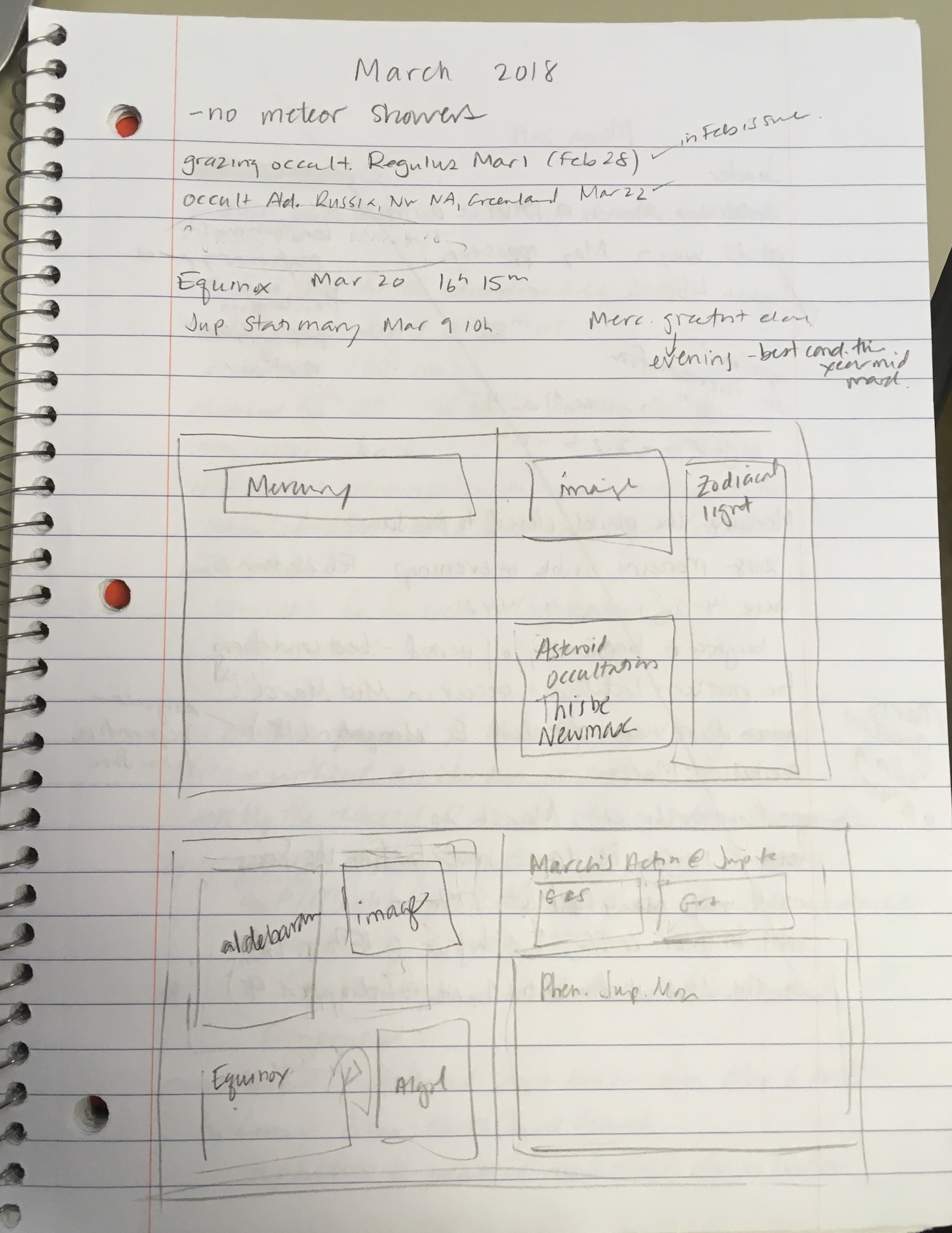
Notes for March 2018 CelCal layout.
I have a spiral notebook I use to work out basic ideas. I scribble a bunch of random notes in it, maybe form a paragraph or two, then go back to my computer to write a first draft. The notebook also has about 10 pages dedicated to “stuff about meteor showers that doesn’t really change,” so I have to keep it around even though it’s almost full. My best guess is that it takes 18 months of CelCal and one issue of SkyWatch to fill a notebook.

Notes for column on Mercury. The slash means “old month, do not read, out of date”.

Notes for Mercury sidebar.
I usually plan for the main story to take two pages. Although the March 2018 CelCal didn’t require a finder chart, if I’d been writing about a comet or an asteroid opposition, I would have needed one. I draw charts with an in-house program, then work with our design department to bring them into our house style/make them more useful. It usually takes me a few hours (creating, proofing, submitting to design, proofing the version finished by design) to make a chart. The typical opening CelCal spread has text, an image (or two), and a finder chart. I got to write a Mercury sidebar for March 2018 to fill the space where a chart would have been placed.
The second 2-page spread of CelCal is where I put things like occultations, major meteor showers that will be Mooned-out, etc. I can write about these in shorter paragraphs, so I can sometimes fit three topics in, depending on whether Algol predictions run or I need to write a lot about Jupiter.

March 2018 CelCal occultation predictions.

Roger Sinnott does the wigglegram, and I’m grateful to the IMCCE for sharing data.
After I get all the text written, I compile it into one document and format it to meet our house styles. This includes coming up with titles, subtitles, run-heads, captions, captions ledes, table headings, and so on. I select the images and charts that I want to run with the column as I go. Images need to get art-department approval, so I’m required to run my choices by them early in case I need to find something else. Once I have everything in a complete state, I give it all over to our Observing Editor. She double-checks everything I’ve written, right down to the extra blank space I tend to leave at the end of my paragraphs (you never know, that blank space might mess up the formatting of a paragraph one day). After she makes corrections, I go through the document again to see if I agree with the changes she’s made (usually I do, but not always. It makes me feel good to press “REJECT” every once in awhile).
After we come to an editorial consensus, which can take a bit of back and forth, I submit the full text and images to the art department. The art department does the layout as they see fit, trying to strike a balance between “communicates clearly” and “looks great.” Sometimes surprises happen at this point — an image doesn’t work after all, I messed up something on a chart, my text is too long, my text is too short, I wrote “standard time” instead of “daylight-saving time” — but usually the surprises are small and everything can move forward. I proof the proposed layout, then send it back to the art department. They finalize the layout, and send it to the Editor in Chief. He proofs the final layout. I proof it again. And then it all goes back to the art department for final production packaging. The entire magazine is sent to production at some point (not my job!), and soon after that, the digital files come back to our office for a final check by the Editor in Chief and Art Director before printing.

First run at asteroid occultation.
A lot of people work on those four pages! Editorially, I’m pretty independent. I’m best situated to know what’s “important” in the sky in any given month, so I choose the topics I’ll cover as I see fit. But in the end, many people collaborate to finish the pages — two editors (minimum), the design department, the art department, the Editor in Chief — so I can’t take the credit even if my name is at the top of the page.

Tokyo Astronomical Observatory Map of the Sun, March 21, 1959. Image: Kodaikanal Observatory Library / JR
I found a whole book of these maps of the Sun made for the International Geophysical Year (July 1, 2957 to December 31, 29158) in the library at Kodaikanal Observatory. It took me awhile to track down their origin, but I finally found the entire collection online at the Solar Science Observatory of the National Astronomical Observatory, Japan. (Scroll down to the section of the table that says “Map of the Sun in the IGY period),
According to the Historical Sunspot Drawing Resource Page:
According to the National Observatory of Astronomy Japan (NOAJ), the dome housing the 20-cm refractor built in 1921 by Mr. Chodayu Nishiura. The refractor, set on an equatorial mount with clock drive, was used to map sunspots from 1938 to 1999.

The dome for the 203-mm f/18 Zeiss refractor at the NOAJ Mitaka campus.
Image: おむこさん志望 / Wikimedia Commons / CC BY-SA 3.0

Venus and Mars with Sigma Leonis, October 5, 2017. Image: JR
To say that I got up early to view yesterdays’ close conjunction of Venus and Mars would be stretching the truth. My alarm went off the same time it does every weekday morning, so viewing it took no special effort on my part. And If I’m telling the 100% truth, I’m saying that I can see Venus from an upstairs window, so technically, I didn’t even have to go outside for a decent naked-eye or binocular view of the event. (Remember, I’m the person who once did an entire day of solar observing with a 130-mm reflector from inside the house.)
Mars and Venus were about 1/4° apart yesterday morning (October 5th) as viewed from Metrowest. Sigma Leonis was something like 19 arcminutes from Venus. Through binos, the difference between 15 and 19 arcminutes is obvious.
Mars and Venus had moved on this morning. Detectably orange Mars stood about 1/2° upper right of Venus (1 o’clock on the dial), with Sigma about 1-1/4° directly above Venus.
Sometimes I think successful observing is all a matter of confidence. I go through this same sequence every time I look for some moving target: an asteroid, a dim planet, a comet. I study the starfield, sketch what I see, but nearly always convince myself I’m looking in the wrong place because the field doesn’t look quite right. Well, there’s a reason it doesn’t look right, and that reason is either a comet, an asteroid, or a dim planet. My first view of Uranus or Neptune in the fall? I have to starhop over and over to the field because something seems off. Find a comet? Same thing. Finding an asteroid? Same deal. It took me forever to believe I was really seeing Florence. Not sure why I don’t just trust my eyes.

Asteroid 3122 Florence, viewed from Metrowest, August 30, 2017, 15×70 binos. Image: JR
This was our first trip to the Cherry Springs Star Party. I wrote a fairly comprehensive summary for the S&T site awhile back. Here are a few random photos from the trip. One advantage of being the Observing Editor at S&T is that I can stay late at work at draw my own star charts. Before going to Cherry Springs, I put one together for Comet Johnson (C/2015), and I have to say, it was admirably accurate.
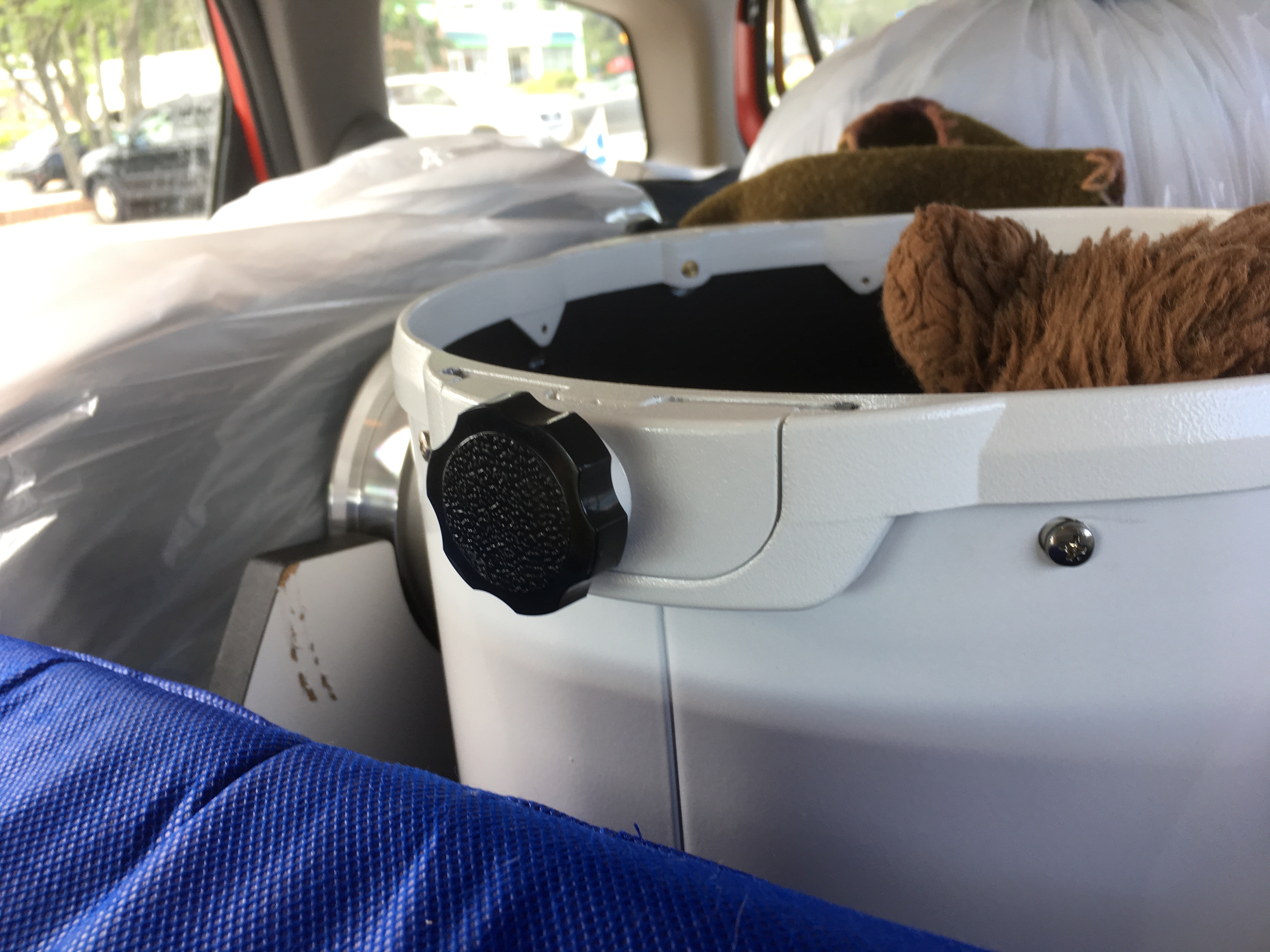
Stuffed animals make good rattle reducers. Image: JR
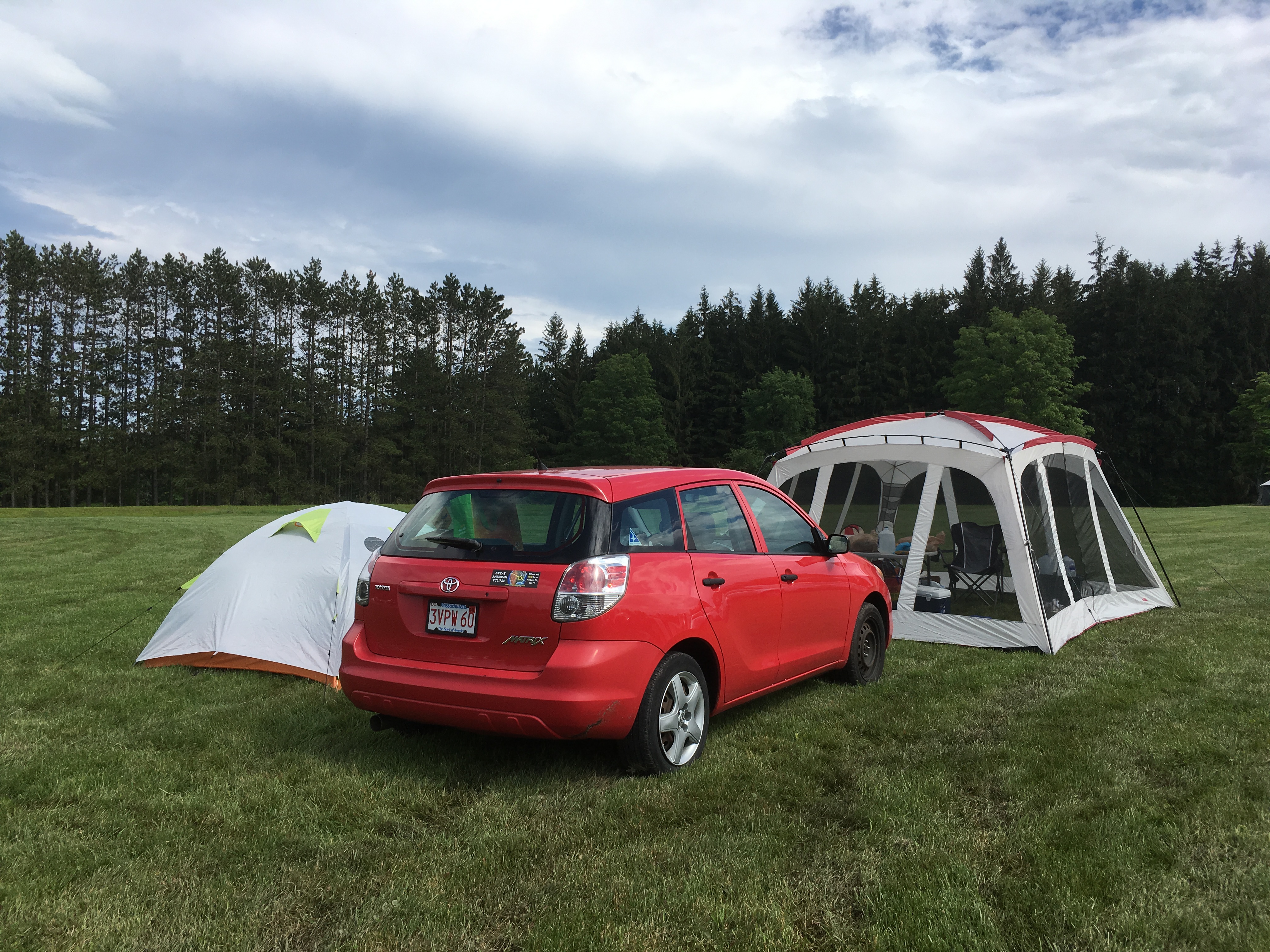
All set up at Cherry Springs, just waiting for clouds to go away. Image: JR
Next year, remind me to park on the other side of the tent. I thought this would give us some privacy from neighbors on the west side, but it turns out they left for a hotel every night anyway. If I’d parked on the other side, I would’ve had better protection from the morning Sun.

Observing table, ready to go but crowded. Image: JR
One good thing about attending a star party within driving distance is that you can pack a lot of stuff in even a small car. This is the first star party in a long time where I’ve had at least one decent observing table. In an ideal world, Catherine and I would both have our own tables plus a couple of side tables. I prefer print atlases and they take up a lot of room. Plus, we both have 3-ring binders we use as observing notebooks, and then we both have sketch books. There’s pens and pencils, a bin for extra batteries, a bin for setting our lights (so I can always find it again in the dark).

Meade Lightbridge, finally uncovered. Image: JR
I guess another advantage of working at S&T is that I can borrow one of the random scopes sitting around the office when I need to. My 10-inch is way to heavy to drag across state lines, so I bogarted the Lightbridge that lives on the landing of our office staircase for the week. Really easy to transport and set up, I would definitely consider buying one of these if I had $700 burning a hole in my pocket. I saw many 12-inch and 16-inch Lightbridges in use this summer. I think the 16-inch would fall into the “too heavy to move around” category for me, but I wouldn’t say no to the 12-inch.

Good height for short person. Image: Catherine Johnson-Roehr
As you can see from this photo, the Lightbridge is a good height for me (I’m 5′ 1″ tall). Like all Dobs, it can get a bit awkward when looking at objects close to the horizon (on this night, I was showing off the Andromeda Galaxy to other observers, basically from a crouched position), but when I’m 1/2-way up the sky or more, I find it very comfortable.

Star splitter extraordinaire. Image: JR
Catherine seems really comfortable with her refractor these days. She’s been using it for double stars, plus doing a lot of bino observing. This summer, she used the Irish Federation of Astronomical Society’s Binocular Certificate Handbook to build her observing lists.

Finally, one clear night. Image: JR
We had one clear night of observing only, so I didn’t make much headway on my observing list. I had planned to do some mapping of the Virgo Cluster, but the light management on Saturday night was really, really bad. Our neighbors to the west opened their trunk at least 5 times, destroying my night vision over and over again. The experience was frustrating enough for me that next time I’ll take a little more time to think about how to isolate my scope from the public — not usually my goal at a star party, but possibly a necessary step to enjoy this one to the fullest.

Tracked down Comet Johnson with the 15 × 70 binos before going after it with the scope. Image: JR

Needle Galaxy and M109. Image: JR
 Sky and Telescope News